Analysis by CardinalClaw · Updated
Why marketing for contractors is different
Construction is not one market. It is hundreds of trades — roofing, remodeling, concrete, HVAC, electrical — that happen to share a customer and a search box. Marketing that ignores that ends up generic, and generic is exactly what the directories sell.
The pool is enormous. The U.S. Bureau of Labor Statistics counts roughly 8 million people working in construction, and the U.S. Census Bureau tracks construction spending running past $2 trillion on an annualized basis. That scale is why national platforms fight so hard for the contractor's marketing dollar — and why a single contractor can feel invisible inside it.
It is also a licensed trade, which is leverage most marketing throws away. In North Carolina, any project of $30,000 or more requires a license from the North Carolina Licensing Board for General Contractors (NCLBGC). A license number, a clean safety record, and named manufacturer certifications are facts a buyer can verify — and facts are exactly what both Google and AI engines reward. A directory listing cannot show any of that.
Then there is the part most contractors have not priced in yet: the search itself is changing. Buyers increasingly ask ChatGPT, Perplexity, Gemini, or Google AI Overviews "which contractor near me should I hire" and read one named answer instead of scrolling ten blue links. If your site is not structured for those engines to quote, you are absent from the only answer the buyer sees. That is the gap answer engine optimization closes.
What a contractor can prove that a directory cannot
- A license number on file with the state board
- An OSHA-compliant safety record
- Manufacturer and product certifications
- Photographed, dated local jobs
- Written warranty terms in plain language
The search data behind marketing for contractors
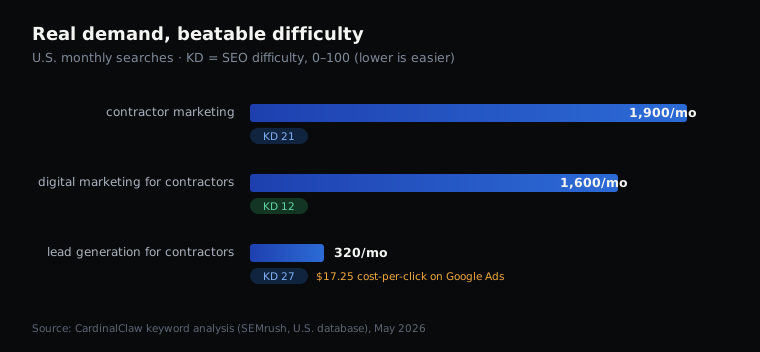
We pulled the live U.S. search landscape for the terms contractors actually compete on, then we measured the Authority Score of every organic result sitting on page one. We found the demand is real and the competition is soft: not one page-one site we measured scored above 18 out of 100. In SEO terms, 100% of the page-one field is beatable with genuinely useful pages.
| Keyword | Searches / mo | SEO difficulty | Avg. CPC |
|---|---|---|---|
| contractor marketing | 1,900 | 21 | — |
| digital marketing for contractors | 1,600 | 12 | — |
| lead generation for contractors | 320 | 27 | $17.25 |
Source: CardinalClaw keyword analysis (SEMrush, U.S. database), May 2026. SEO difficulty is a 0–100 score where lower is easier.
Difficulty score is one signal; who actually ranks is another. So we measured the Authority Score — a 0-to-100 estimate of a domain's ranking strength — of every site on page one for "digital marketing for contractors." The result is a field of weak incumbents.
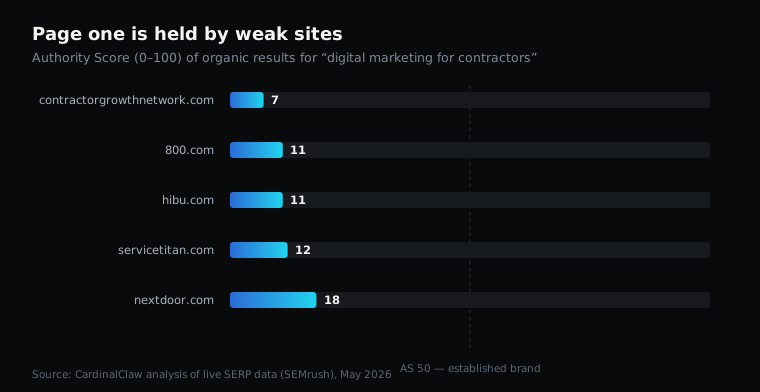
That combination — thousands of monthly searches, single-digit-to-teens difficulty, and incumbents scoring 18 or lower — is rare. It is why we tested this vertical before pitching it: the math says a focused contractor site can take page one, and the AI engines, which lean on the same authority signals, will follow.
What contractors actually pay for customers
Every contractor is already buying customers somehow. The question is which of three channels you are funding, and whether the money buys a flow that stops or an asset that compounds. Here is how the three compare on real numbers, not slogans.
Google Ads
You pay for the click whether or not it becomes a job. Contractor lead terms run about $17 and up, and the traffic ends the day the card stops.
Directories
Angi Inc. and Thumbtack Inc. resell the same lead to three to five contractors. You compete on price the second it lands, and the supply is theirs, not yours.
SEO + AEO
A retainer builds ranking and AI citations you keep. The fee is fixed while the leads compound, so cost-per-job falls the longer it runs.
The ranges above are industry-typical, not a quote — your numbers depend on your trades and market. The structural point holds regardless: paid clicks and rented leads are rentals that reset to zero when you stop, while earned ranking is the only channel where this month's spend still works next year. For most contractors the right move is to run paid ads for immediate calls and build earned ranking underneath, then shift budget toward the asset as it matures.
How we build marketing for contractors that compounds
We do not spin up a template per town or per trade — thin pages built that way get filtered by Google and ignored by AI. We build a small number of pages that each carry real, verifiable detail, then we measure and expand what earns work. The sequence is the same whether you do roofing, remodeling, or full general contracting.
Audit and baseline
We measure where you rank on Google today and whether ChatGPT, Perplexity, Gemini, and AI Overviews name you. That baseline is the number we hold ourselves to.
Fix the foundation
Site speed, schema markup, and a fully built Google Business Profile come first. A page cannot rank or be cited if the engines cannot read and trust it.
Publish proof
We turn your licenses, certifications, warranties, and real jobs into trade pages and FAQ content that the engines can quote directly — the facts a directory can never show.
Measure and compound
We track rankings and AI citations every month, retire what does not move, and pour effort into the pages that bring calls. The asset gets stronger on a fixed budget.
What is included every month
- Rank tracking on Google plus AI-citation checks
- Google Business Profile management
- New trade and FAQ pages built to be cited
- Schema markup and technical fixes
- A plain-English report you can act on
Contractor marketing FAQ
How much does digital marketing for contractors cost?
Contractors pay for customers three ways. Google Ads clicks on contractor lead terms average about $17.25 each and stop the day you stop paying. Shared directory leads from Angi and Thumbtack typically run $15 to $100 each and are resold to several contractors. An earned-ranking retainer that builds SEO and AI citations typically runs $1,500 to $4,000 a month and keeps producing after the work is done.
How long until contractors see leads from SEO?
Local map-pack and AI-citation gains often appear within 60 to 90 days because the page-one competition for contractor terms is weak. Competitive organic rankings for the highest-volume keywords usually take 4 to 8 months. Paid ads can produce calls the same week, which is why we often run ads while the earned ranking builds underneath.
Is it better to buy leads from Angi or rank on Google?
Bought leads arrive fast but are sold to three to five contractors, so you compete on price the moment one lands, and the supply ends when you stop paying. Earned ranking costs more up front in time, but the same money buys an asset that keeps sending work. Most contractors should run both and shift budget toward ranking as it matures.
What is answer engine optimization for contractors?
Answer engine optimization, or AEO, is structuring your site so ChatGPT, Perplexity, Gemini, and Google AI Overviews name your company when a buyer asks who to hire. It relies on schema markup, direct-answer formatting, and verifiable facts such as license numbers and real job data. It matters because a growing share of buyers now read one AI answer instead of clicking ten results.
Do I need a separate page for each trade I offer?
Only for trades with real search demand and real margin. A dedicated page for roofing, remodeling, or concrete can rank and be cited when it carries unique detail, but thin pages spun up for every service hurt more than they help. We build pages where the data shows demand, not on a template.
Will contractor marketing work outside Western North Carolina?
Yes. The demand and weak page-one competition shown above are national U.S. figures, and the method works in any market. CardinalClaw is based in Asheville and Hendersonville, North Carolina, and also serves contractors nationwide because the search mechanics do not change by ZIP code. See our roofing marketing breakdown for a trade-specific example.